Local SEO KPIs: What to Measure Beyond Rankings
Expert reviewed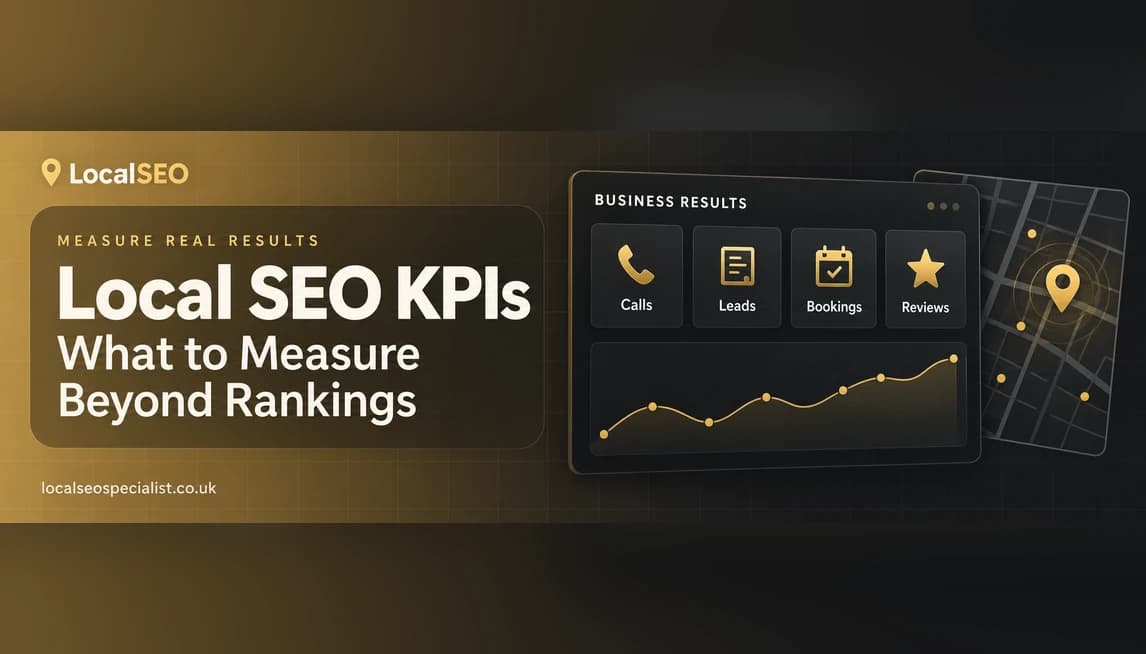
A senior local SEO team explains the local SEO KPIs that actually matter beyond rankings, how to measure each one, which tools to use, and how to report results in a way a busy business owner understands.
The local SEO KPIs you should measure beyond rankings are the ones that show real business results: Google Business Profile calls, direction requests and website clicks; map pack visibility and share of local voice; local organic traffic; leads and conversions; phone calls and form fills; review count, average rating and review velocity; citation and NAP consistency; and click-through rate. Rankings are a means to an end. These KPIs tell you whether that end, more paying customers, is actually happening.
We are Nazir Abbas and Javed Iqbal, senior specialists at Local SEO Specialist. We report on these numbers every month for clients across London, Manchester, Birmingham, Leeds, Glasgow and Bristol, from plumbers and electricians to dentists and solicitors. This guide is the same scorecard we use with them, so you can measure what matters and stop obsessing over a single ranking.
Before we run through the KPIs, one plain point. A ranking is not money. A business owner cannot pay a supplier with a number one position. So we treat rankings as an early signal and put the weight on the KPIs that track calls, clicks, leads and sales. Here is the full list, how to measure each one, and how to present it all without drowning anyone in data.
Key takeaways
- A local SEO KPI is a number that tracks progress towards more customers, not just a higher position in search.
- Rankings alone mislead because local results change street by street and a strong position can still bring zero calls.
- The KPIs that matter most are Google Business Profile actions, map pack visibility, local traffic, leads and conversions, and reviews.
- Measure with a small set of tools: Google Business Profile Insights, Google Search Console, Google Analytics, call tracking and a geo-grid tracker.
- Report monthly, lead with leads and calls, and translate every number into plain business language for the owner.
On this page
How we chose these KPIs
We chose these KPIs by working backwards from what a local business owner actually cares about, which is more enquiries and more paying jobs. Every KPI on this list either measures a real business action, such as a call or a form fill, or it measures a signal that reliably leads to those actions, such as map pack visibility or review count. If a metric looked impressive but did not connect to money, we left it off.
We also weighted the KPIs, because not everything deserves equal attention on a monthly report. Leads and conversions carry the most weight, because they are the closest thing to revenue. Google Business Profile actions and map pack visibility come next, since for most local businesses the map is where the customer decides. Supporting KPIs like citations and click-through rate matter, but they are inputs, so they sit lower on the scorecard.
Leading and lagging KPIs
Some KPIs are leading, meaning they predict results, such as review velocity or map pack visibility. Others are lagging, meaning they confirm results, such as leads and calls. A good report shows both, so you can see what is working now and what is about to work.
- Leading: map pack visibility, review velocity, citations
- Lagging: calls, form fills, direction requests, closed jobs
What a local SEO KPI is, and why rankings alone mislead
A KPI, or key performance indicator, is simply a number you agree to watch because it tells you whether your local SEO is moving in the right direction. A good KPI is measurable, it is tied to a business outcome, and it changes when your work changes. A ranking can be a KPI, but on its own it is a weak one, and here is why.
Local search results are personalised by location. If you are a dentist in north Leeds, a person searching two miles away may see three different practices in the map pack. So the position you see from your own desk is only one view out of hundreds. Worse, when you search for your own business again and again, Google learns you like it and shows it higher to you than to a stranger. You can be sitting at a comfortable number one in your own browser while real customers a few streets away never see you.
There is a second trap. You can rank well and still get no work. A business can hold the top spot for a keyword and receive almost no calls because the listing has no reviews, a weak description, or a phone number nobody clicks. Rankings measure position. They do not measure whether anyone chose you. That gap is exactly why we measure the KPIs below.
Why rankings on their own mislead
A ranking tells you where you appear, not whether it earned you a customer. Local positions shift by location and by searcher, so a single ranking check is a snapshot from one spot, on one day, for one person. Always pair rankings with KPIs that measure real actions, such as calls, clicks and conversions.
- Position changes street by street, so one check is not the truth
- You can rank first and still get zero enquiries
- Real KPIs measure what the customer did, not where you sat
1. Google Business Profile actions: calls, directions and website clicks
For most local businesses, the Google Business Profile is the shop window, so the actions people take on it are your most direct KPIs. There are three to watch. Calls are people tapping the phone number straight from your listing. Direction requests are people asking Google to route them to your address, which is a strong buying signal for anyone with premises. Website clicks are people tapping through to your site to learn more or book.
You measure these inside the Google Business Profile performance view, which Google updates each month. Track the totals, but pay more attention to the trend. A steady rise in calls and direction requests over three to six months is a much better sign than one good month. Break the numbers down by month, and note anything that could explain a jump or a dip, such as a new set of photos, a run of fresh reviews, or a bank holiday. If you have not tuned your listing yet, our guide on how to optimise your Google Business Profile walks through the changes that move these numbers.
One caution. Google has changed how it counts and labels these actions more than once, so do not panic over a single odd month. Watch the direction of travel across a quarter, and treat calls and direction requests as the headline actions, because they map most closely to real customers walking in or picking up the phone.
3. Local organic traffic
Local organic traffic is the number of visitors who reach your website from unpaid search. It matters because your site is where many customers read your service pages, check your prices and finally book. You measure it in Google Analytics for the volume and in Google Search Console for the search side, such as which queries and pages bring people in.
For a local business, do not just watch the total. Look at traffic to the pages that earn money, such as your service pages and your location pages. Ten extra visitors to your emergency plumber page in Manchester are worth far more than a hundred extra visitors to an old blog post. In Search Console, filter by the queries and pages that show clear local intent, and watch whether impressions and clicks are climbing on those. A steady rise there usually shows up as more calls and forms a month or two later.
Segment the traffic by device and by town where you can. Most local searches happen on a phone, often when someone is out and ready to buy, so a growing share of mobile traffic to your booking and contact pages is a healthy sign. If you serve several towns, watch each location page on its own, because a rise in one area and a fall in another tells you where your work is landing and where it needs a push. This is far more useful than one blended number that hides the detail.
4. Leads and conversions: the KPIs that pay the bills
This is the KPI cluster that matters most, because it is the closest thing to revenue. A conversion is any action you count as a genuine enquiry: a phone call, a form fill, a WhatsApp message, a quote request or a booking. Rankings, traffic and visibility are all just the road that leads here. If conversions are not rising, the rest is decoration.
Measure form fills and bookings as conversions in Google Analytics, and measure phone calls with a call tracking number so you can see which calls came from search rather than from a flyer or a repeat customer. Split your leads by source where you can, so you know how many came from the Google Business Profile versus the website. And go one step further than most: agree with the owner on a rough value per lead, so the report can show not just twenty enquiries but an estimated value those enquiries represent. That single move turns your work from a cost into an investment in the owner's eyes.
Phone calls and form fills need setup
You cannot report call and form KPIs accurately without the right tracking in place. Use a call tracking number that swaps in on the site and listing, and set your contact and booking forms as tracked conversions in analytics. Get this done before the first report, or you will be guessing.
- Call tracking number to separate search calls from the rest
- Form and booking events set as conversions in analytics
- An agreed value per lead so results read in pounds, not just counts
5. Reviews: count, average rating and review velocity
Reviews are both a ranking factor and a conversion factor, which makes them one of the highest value KPIs in local SEO. There are three numbers to watch. Review count is your total. Average rating is your score out of five. Review velocity is how many new reviews you gain per month, and it is the one most people forget, even though Google and customers both notice a listing that keeps earning fresh reviews over one that stopped a year ago.
Measure count and rating straight from your Google Business Profile, and track velocity by simply recording the total on the same day each month and noting the change. Watch how you respond too, because replying to reviews is a habit Google rewards and customers respect. If earning reviews is your weak spot, our guide on how to get more Google reviews gives you a simple system to raise all three numbers at once.
6. Citations and NAP consistency
A citation is any online mention of your business name, address and phone number, together known as your NAP. Citations live on directories and listing sites, and consistent citations help Google trust that your business details are correct. NAP consistency is the KPI here: across the web, do your name, address and phone number match exactly, or are there old addresses and wrong numbers floating about?
This is a supporting KPI, not a headline one, so measure it a few times a year rather than every month. Use a citation tracker or run a periodic local SEO audit to find listings that are missing, duplicated or wrong. Report it as a simple health score, such as the share of key directories where your NAP is correct, and a short list of fixes. It rarely moves fast, but a messy citation profile quietly holds back everything else, so it earns its place on the scorecard.
7. Click-through rate
Click-through rate, or CTR, is the share of people who see your listing in search and actually click it. You find it in Google Search Console, where you can compare impressions with clicks for your pages and queries. CTR is useful because it tells you whether your listing is appealing, not just whether it appears. Two businesses can rank in the same spot, yet the one with a sharper title, a better description and strong reviews wins far more of the clicks.
Treat CTR as a diagnostic KPI. If a page has high impressions but a low click-through rate, that is a clear signal to improve the title, the meta description or the review count that shows in the result. A small lift in CTR on a page that already ranks can add more traffic than chasing one extra ranking position, so it is a quiet win worth reporting.
One thing to remember with CTR is that it changes with position, so compare like with like. A listing sitting in third place will naturally earn a lower click-through rate than one in first, so judge each page against pages in a similar spot rather than against a flat target. Used that way, CTR points you to the listings that punch below their weight, and those are usually the fastest pages to improve.
The local SEO KPI table at a glance
Here is the full set in one place: what each KPI tells you, where to measure it, and how often to check. Use this as the backbone of your monthly report.
| KPI | What it tells you | Where to measure it | How often |
|---|---|---|---|
| GBP calls, directions and website clicks | How many people took a direct action from your listing | Google Business Profile performance view | Monthly |
| Map pack visibility and share of local voice | How visible you are in the local pack across your area | Geo-grid rank tracker | Monthly |
| Local organic traffic | How many people reach your money pages from search | Google Analytics and Google Search Console | Monthly |
| Leads and conversions | How many real enquiries your SEO produced | Analytics goals and call tracking | Monthly |
| Phone calls and form fills | Which channel and page drove each enquiry | Call tracking and form events | Monthly |
| Review count, rating and velocity | Trust signals and momentum on your listing | Google Business Profile | Monthly |
| Citation and NAP consistency | Whether your business details are correct across the web | Citation tracker or local SEO audit | Quarterly |
| Click-through rate | Whether your listing is appealing, not just visible | Google Search Console | Monthly |
Our recommended local SEO scorecard, and how to present it
Not every KPI deserves equal billing. Below is how we weight a local SEO scorecard, so the report leads with the numbers that matter most to the owner. This is our recommendation from years of client reporting, not an external standard, so adjust it to fit the business. A takeaway restaurant might weight direction requests higher, while a solicitor might weight form fills higher.
Source: Local SEO Specialist recommended weighting
When you present this to a business owner, keep it short and human. Lead with leads. Open the report with how many enquiries and calls came in, and their rough value, before you touch any ranking or visibility number. Then show the trend over several months, not just this month, because the story is in the direction. Use the map pack heatmaps to make visibility visual, and finish with two or three plain next steps. An owner should be able to read the first page and know, in thirty seconds, whether things are getting better.
How to report so an owner actually reads it
Most owners do not want a data dump. They want to know if the phone is ringing more and whether it was worth the money. Build every report around that.
- Put leads, calls and their value on page one
- Show three to six months of trend, not a single month
- Turn map pack data into before-and-after heatmaps
- Translate every KPI into one plain sentence
- End with two or three clear next actions
If all of this feels like a lot to set up and maintain, that is normal, and it is a big part of what a good local SEO specialist does month to month. The tools matter less than the habit: measure the same KPIs on the same day each month, tie them to real business results, and report them in language the owner understands.
Local SEO KPIs: FAQs
What is the most important local SEO KPI?
Leads and conversions, because they are the closest thing to revenue. A phone call, a form fill or a booking is proof that your local SEO produced a real customer. Rankings, traffic and visibility all matter, but they are the road that leads to conversions, so we put the most weight on the enquiries themselves and their rough value in pounds.
Why should I not just track rankings?
Because local rankings change street by street and searcher by searcher, so a single ranking check is one snapshot from one spot on one day. You can also rank first and still get no enquiries if your listing has few reviews or a weak description. Rankings measure position, not whether anyone chose you, which is why you pair them with KPIs like calls, clicks and conversions.
How often should I report on local SEO KPIs?
Monthly for the main KPIs, such as calls, conversions, map pack visibility, traffic and reviews. Report citation and NAP consistency quarterly, since it moves slowly. Always show several months of trend rather than a single month, because the story is in the direction of travel, not one good or bad month.
Which tools do I need to measure local SEO KPIs?
A small set covers almost everything. Use the Google Business Profile performance view for calls, directions, clicks and reviews, Google Search Console for impressions, click-through rate and queries, Google Analytics for traffic and form conversions, a call tracking number for phone leads, and a geo-grid rank tracker for map pack visibility and share of local voice.
What is share of local voice?
Share of local voice is a single score from a geo-grid tool that shows how visible you are in the map pack across your whole service area, compared with the maximum possible. The tool checks your position from many points around your town and rolls the results into one percentage, which makes it an easy KPI to track month to month and to explain to an owner.
How do I measure phone calls from local SEO?
Use a call tracking number that swaps in on your website and, where possible, your listing, so you can separate calls driven by search from calls driven by flyers, referrals or repeat customers. Without call tracking you are guessing, and phone calls are often the biggest source of enquiries for local businesses, so it is worth setting up before your first report.

Nazir helps UK businesses get found in Google Maps, the local pack and AI search. He writes practical local SEO guides based on hands-on experience with real campaigns.
Editorial process: every guide is researched and written by a local SEO specialist, reviewed by Javed Iqbal, and checked for accuracy before it is published.
More guides
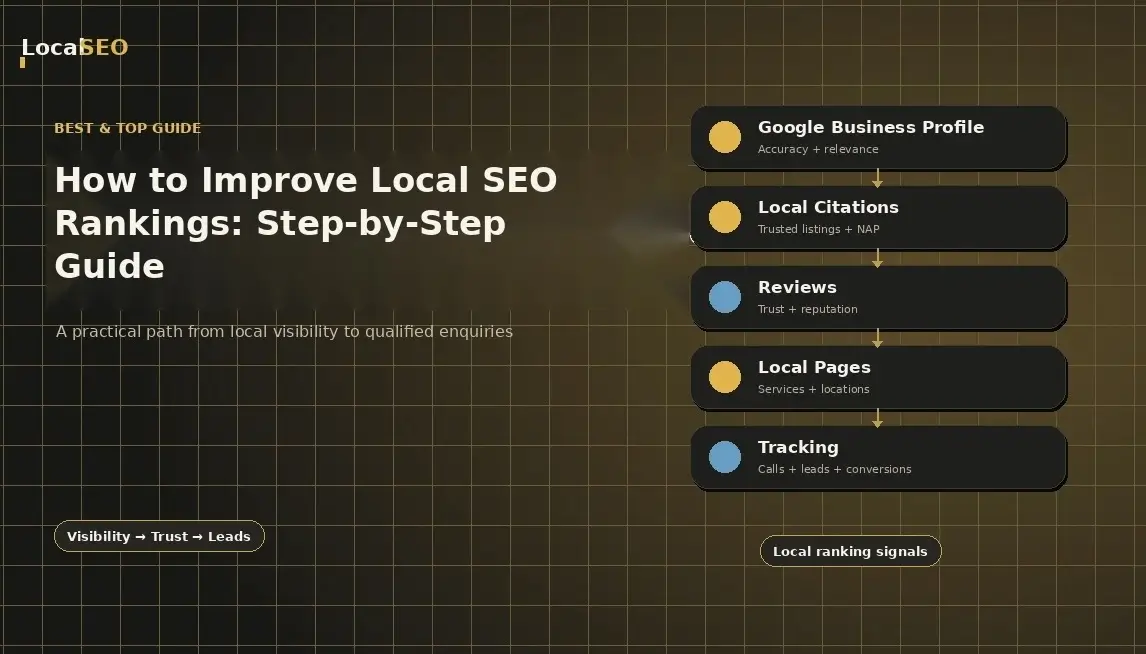
How to Improve Local SEO Rankings: Step-by-Step Guide
People in your area are already searching for the products and services you sell. The problem is that they may never find you.
Read the guide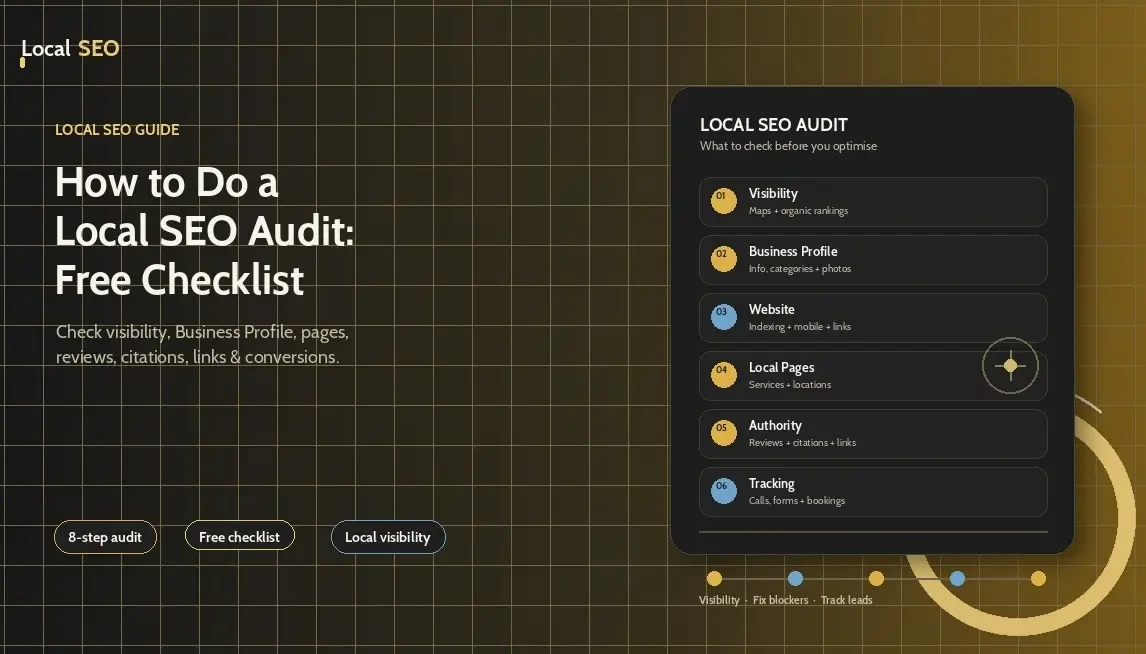
How to Do a Local SEO Audit: Free Checklist
A local SEO audit shows you what is helping a business appear in local search, what is holding it back, and what needs fixing first. It looks beyond rankings and checks the full path from a Google search to a call, booking, form submission, or store visit.
Read the guide
How to Choose Google Business Profile Categories (UK Examples)
A plain, senior guide to choosing the right primary and additional Google Business Profile categories, with UK trade examples and the mistakes to avoid.
Read the guideSee exactly where you're losing local customers
Get a free, no-obligation local SEO audit and a clear plan to climb the map pack.
- A clear picture of where you rank locally today
- The quickest wins to climb the map pack
- How you compare to nearby competitors
- No obligation, no hard sell
Prefer to talk? Call us directly.
+44 7423 614766