
Quick Summary
- A local listing directory is a website that holds your business’s name, address, phone number, hours, and reviews in one profile, and search engines check that profile against every other mention of your business online.
- They matter because Google cross-checks your details across trusted sources to decide whether your business is legitimate, and that trust feeds directly into your map pack ranking.
- For UK businesses, the priority order runs Google Business Profile first, then Bing Places and Apple Business Connect, then UK-specific directories like Yell, Thomson Local, and FreeIndex, then industry platforms like Checkatrade.
- Quality beats quantity every time. Twelve accurate listings will outperform a hundred sloppy ones, and cleaning up a messy citation profile is usually more valuable than adding new listings to it.
A local listing directory is a website where your business shows up with its name, address, phone number, and a handful of other details customers rely on. Most business owners have heard the word “citations” thrown around by an SEO agency and nodded along without really knowing what it meant. If that’s you, you’re in the right place.
Here’s the situation we run into constantly. A UK business owner gets told they “need citations,” goes looking for a guide, and finds a list stuffed with American directories they can’t even join. Better Business Bureau. Angi. Healthgrades. None of it applies to a plumber in Leeds or a dentist in Cardiff. Roughly 46% of all Google searches carry local intent, and a huge share of them are happening on phones held by people standing a few streets from your door. That’s not a small opportunity to get wrong.
Everything below reflects the directories our team actually builds and cleans up for UK clients, not a scraped list of names nobody has verified in years.
What Are Local Listing Directories?
A local listing directory is a website that stores structured information about your business. This usually covers your name, address, and phone number, plus hours, photos, a short description, and often a space for customer reviews. Directories exist so search engines and customers can find consistent facts about a business without visiting its website first.
Think of a listing as a mini version of your homepage that lives somewhere else. Google Business Profile is the best-known example, but dozens of smaller directories serve the same basic function. Some are general, covering every type of business. Others focus on a single trade, like Checkatrade for builders and electricians. A complete listing usually includes a link back to your website too, and that link carries a small amount of SEO value on its own.
Listings vs Citations: Are They the Same Thing?
Not quite, and almost nobody explains the difference cleanly. A listing is the full profile page itself: hours, photos, reviews, and all. A citation is any mention of your NAP (name, address, phone number) online, whether or not it sits inside a full profile. A guest post that mentions your bakery’s address in passing counts as a citation. It isn’t a listing.
Every listing creates a citation. Not every citation comes from a listing.
Why Are Local Listing Directories Important for Local SEO?
Here’s the mechanism, not just a list of benefits. Search engines can’t call your business to confirm it’s real, so they cross-reference your name, address, and phone number across dozens of independent sources instead. When Yell, Thomson Local, Google, and Facebook all agree on the same details, that consistency reads as trust. When they don’t agree, Google has to guess which version is correct, and guessing rarely works in your favour.
That trust signal feeds what’s known as prominence, one of the three core local ranking factors alongside relevance and distance. Prominence is built slowly, through consistent listings, reviews, and mentions across the web. Directories are one of the cheapest and fastest ways to build it. A business with 62% of consumers saying they’d avoid a company after finding incorrect contact information online, according to BrightLocal, has real money riding on this being right.
Beyond the ranking mechanics, directories do quieter work too. They put your business in front of people who never touch Google at all, since some shoppers go straight to Yelp or TripAdvisor. They generate referral traffic from the directory’s own visitors. Review platforms like Trustpilot give customers another place to leave feedback, which means more reviews overall. Backlinks from established directories add a small amount of authority to your website. And voice assistants often pull answers straight from directory data, so an accurate listing helps you get read out loud too.
Key Takeaway: Directories don’t rank your business directly. They convince Google your business is real, consistent, and worth trusting enough to show someone nearby.
Which Local Listing Directories Should UK Businesses Use?
Before the list, a warning. Most “best directories” guides floating around online are written for an American audience. They’ll tell you to submit to platforms that don’t serve UK postcodes, don’t recognise UK phone formats, and won’t move the needle for a business trading only in Manchester or Bristol. If a guide’s top five recommendations are all American, close the tab and keep reading here instead.
We build listings for UK clients in four tiers, roughly in order of priority.
Tier 1: The Essential Three
Google Business Profile, Bing Places, and Apple Business Connect. These aren’t optional, and they aren’t really “directories” in the traditional sense so much as the foundation everything else sits on. Google Business Profile alone can put you in the map pack. Bing Places feeds Bing’s own local results and, increasingly, Microsoft’s AI tools. Apple Business Connect controls how your business appears on Apple Maps and Siri, which matters more than most owners realise given how many customers search on an iPhone. All three are free.
Tier 2: Core UK Directories
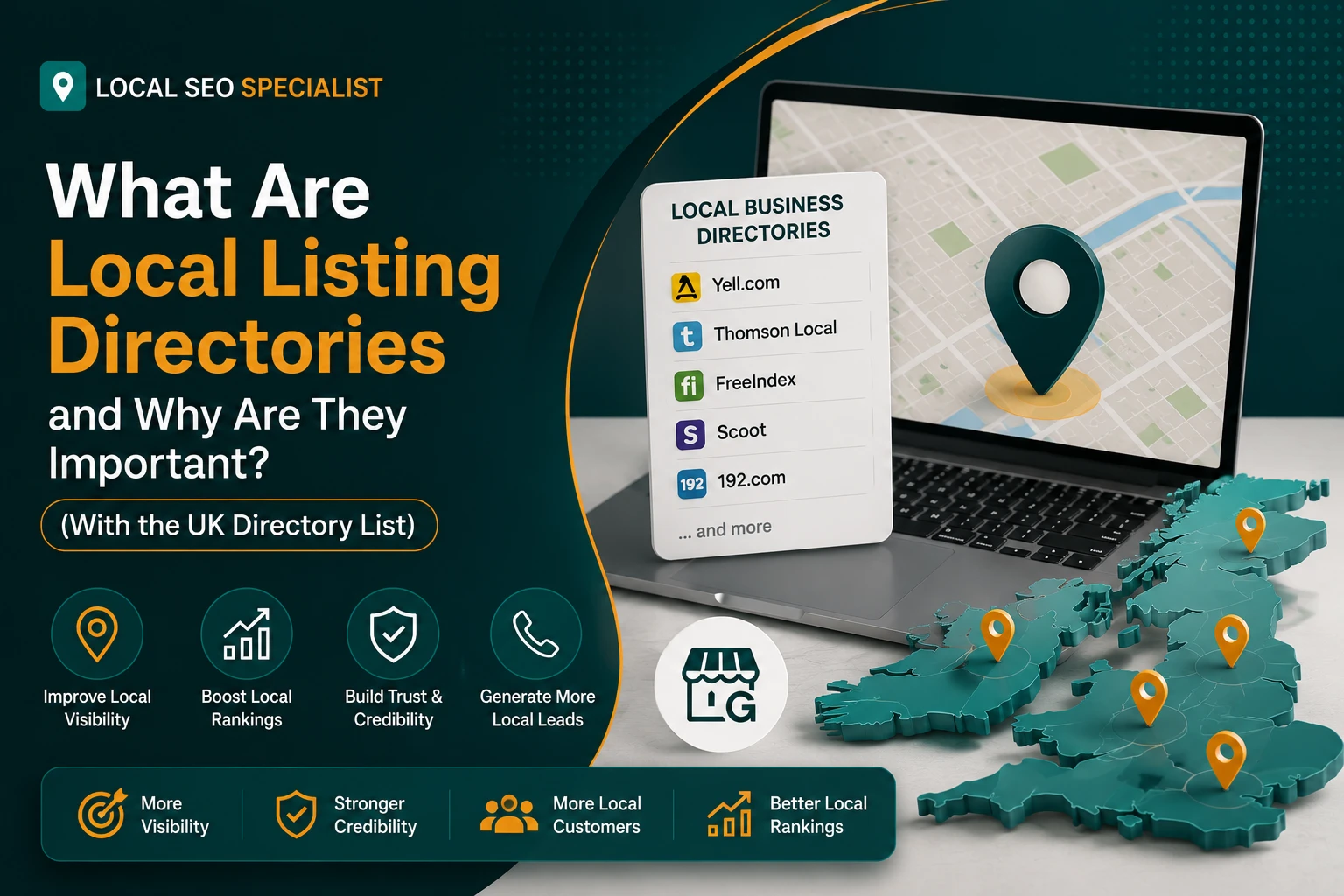
Yell, Thomson Local, FreeIndex, Scoot, 192.com, Cylex UK, Hotfrog UK, Yelp UK, and Facebook. Yell offers a genuinely free basic listing, with premium placement starting around £30 to £100 a month if you want it. Thomson Local and FreeIndex both provide solid free tiers, and FreeIndex in particular leans hard into reviews and direct customer enquiries. Scoot is worth a mention on its own because it syndicates your listing out to several smaller UK directories at once, saving you the trouble of submitting to each individually.
Tier 3: UK Review & Trust Platforms
Trustpilot, plus the trade-specific trio of Checkatrade, TrustATrader, and Rated People. These carry weight because customers actively read reviews on them before making a decision, and 75% of UK consumers say they read reviews for local businesses before buying, per BrightLocal’s research. If you’re a tradesperson and you’re not on at least one of Checkatrade, TrustATrader, or Rated People, you’re leaving a well-worn discovery path completely uncovered.
Tier 4: Industry & Local
This tier depends entirely on what you do. Restaurants and hotels need TripAdvisor and OpenTable. Solicitors should have a current Law Society profile. Care homes and health providers need to appear correctly on the CQC register. Local chambers of commerce and town or community directories round this tier out, and while they won’t drive huge traffic, they reinforce that your business genuinely operates where it says it does.
Verdict: Get the essential three locked down first, add the core UK directories over your first month, then layer in trust platforms and industry listings as time allows.
How Many Directory Listings Does Your Business Actually Need?
This is a question most AI answer boxes fumble, because the honest answer is “it depends,” and nobody likes writing that. Still, a realistic range for a small UK business is somewhere between 15 and 30 well-chosen listings, not the 100-plus some cheap citation services will try to sell you.
Past that core set, you hit diminishing returns fast. A citation on a directory nobody visits, with barely any domain authority, adds almost nothing to your prominence signal. Worse, it’s one more place your NAP details can go stale and drag your consistency score down. Data aggregators like Infogroup and Factual sit slightly outside this count. They don’t hold public-facing listings themselves. Instead, they feed your business data downstream into dozens of smaller directories automatically, which is genuinely useful, but it’s a supplement to your core listings, not a replacement for them.
We’d rather see a client with 20 accurate, monitored listings than 150 they set up once and forgot about.
Are Paid Directory Listings Worth It in the UK?
Sometimes, but not automatically, and this is where a lot of UK businesses waste money. The question isn’t “does this directory look impressive.” It’s whether the directory itself ranks for searches your customers actually type, and whether it sends you real referral traffic beyond the SEO benefit.
Yell’s premium tiers can genuinely help a business in a competitive trade, where Yell’s own search results get real footfall. For a niche B2B company, that same spend is close to wasted, because nobody’s searching Yell for what you sell. Ask any directory sales rep for their actual traffic and conversion numbers before paying anything. If they dodge the question, that tells you something on its own.
One more thing worth flagging, honestly. Several UK directories run aggressive cold-call sales teams, and we’ve had clients pressured into year-long contracts over the phone within a single call. Take the free listing first. Decide on paid upgrades once you’ve seen real numbers, not a rep’s promise of them.
How Do You Set Up a Listing Correctly? (The 6 Rules)
Getting a listing live takes minutes. Getting it right takes a bit more care, and skipping these steps is exactly how NAP inconsistency creeps in later.
Start by standardising your NAP before you touch a single directory. Decide, in writing, exactly how your business name, address, and phone number will appear everywhere, right down to whether it’s “St” or “Street.” Do this first, and every listing afterward stays consistent by default.
Always claim an existing listing before creating a new one. Search for your business by name and phone number first, because directories often auto-generate listings from public records long before you ever sign up. Creating a duplicate on top of an existing profile is one of the most common mistakes we clean up for new clients.
Match your standardised NAP exactly, character for character, on every single platform. Small formatting differences confuse Google more than most owners expect.
Never use a call-tracking number as your primary listed number. Tracking numbers are brilliant for measuring ad performance, but if that number doesn’t match what’s printed on your website and your other listings, you’ve just created an inconsistency you’ll have to hunt down later.
Fill in every available field, not just the required ones. Add your service area, your full list of offerings, and a description that includes the local keywords a real customer would search. An 80% complete profile reads as neglected next to a full one.
Finally, verify the listing once it’s live and set a reminder to check it every few months. Directories occasionally reset fields during platform updates, and stale information does damage quietly, without any alert telling you it happened.
Key Takeaway: Standardise your NAP before you build a single listing. Every rule after that exists to protect the consistency you set on day one.
What Are the Most Common Listing Mistakes?
- Duplicate listings top the list by a wide margin. They happen when a directory auto-generates a profile and a business owner creates a second one without checking first, and Google genuinely doesn’t know which version to trust once that happens.
- Inconsistent NAP formatting comes next. “St” versus “Street,” a missing suite number, an old phone line that was never cancelled, these small mismatches add up across a citation profile faster than owners expect.
- We also see businesses listed on directories that have effectively died, sites with no real traffic and no maintenance behind them, sitting there as dead weight in a citation report.
- Ignoring reviews is another one. A profile with unanswered one-star reviews sitting untouched for a year signals neglect to anyone reading it, customer and algorithm alike.
- Set-and-forget is the pattern behind almost every mistake on this list.
- A cleanup usually means auditing every existing listing, merging duplicates, correcting formatting, and removing anything sitting on a directory that’s gone stale or defunct.
How Do Local Listings Feed AI Search Results?
Here’s the angle most guides on this topic still miss entirely. ChatGPT, Gemini, and Google’s AI Overviews don’t have their own database of local businesses. They cross-check listings, reviews, and citation data from the same directories covered above, then use that data to decide who to recommend by name.
A business with consistent, complete listings across trusted directories gives these AI tools clean data to pull from, which raises their confidence in recommending you specifically. A business with scattered, contradictory NAP details gives an AI system a reason to skip past it and recommend a competitor with tidier data instead. We’re already seeing clients get named directly in ChatGPT answers purely because their Google Business Profile and core UK directories line up perfectly. That’s not a coincidence, and it’s only going to matter more as AI-driven search keeps growing.
Should You Manage Listings Yourself or Use a Service?
Doing it yourself costs nothing but time, and for a single-location business with an afternoon to spare, that’s a completely reasonable choice. The trade-off is speed and ongoing monitoring. Manually checking 20-plus listings every few months for drift is tedious, and it’s the exact kind of task that gets pushed down the priority list until a customer mentions your old address.
A listing management service typically handles the audit, the cleanup of duplicates and inconsistencies, ongoing monitoring, and ideally a monthly report showing what changed. In the UK, this kind of citation work is usually bundled into a broader local SEO retainer rather than sold on its own, and typical pricing for that bundled service runs somewhere between £300 and £800 a month depending on how many locations and directories are involved.
We recently ran a citation cleanup for a client with three locations who’d been trading under two slightly different address formats for years without realising it. Merging duplicates and correcting the formatting across 24 listings took about three weeks, and their map pack visibility for their main location improved noticeably within the following month. Not a dramatic before-and-after story, just steady, measurable progress once the underlying data was finally clean.
If you’d rather see exactly where your own NAP is inconsistent before deciding anything, that’s precisely what a free citation audit is for. We’ll show you what’s currently working, what’s dragging your listings down, and where the fastest wins sit.
So, Are Local Listing Directories Actually Worth Your Time?
Yes, but only the right ones, set up properly, and kept consistent over time. A handful of accurate listings on Google Business Profile, Bing Places, Apple Business Connect, and a handful of solid UK directories will do more for your local rankings than a hundred scattered, half-finished profiles ever could.
Local listing directories aren’t a one-off task you complete and forget. They’re closer to a foundation you check on periodically, the same way you’d glance at your shopfront sign to make sure it’s still lit. Start with the essential three, standardise your NAP before you touch anything else, and build outward from there. Do that consistently, and the trust signal it builds will keep paying off in the map pack long after the initial setup is done.
What is a local listing directory?
A local listing directory is a website that hosts a structured profile of your business, including your name, address, phone number, hours, and reviews. Search engines use these profiles to verify your business is real and to build trust in local search results. Google Business Profile is the most important example, but dozens of smaller directories serve the same purpose.
What are the best free business directories in the UK?
Google Business Profile, Bing Places, and Apple Business Connect come first, since all three are free and foundational. After that, Yell, Thomson Local, FreeIndex, and Scoot all offer genuinely usable free tiers for UK businesses. Most small businesses can build a solid free citation base of 15 to 20 listings without spending a penny.
What is the difference between a listing and a citation?
A listing is a full business profile page, complete with hours, photos, and reviews. A citation is any online mention of your business name, address, and phone number, whether it appears inside a full listing or just in passing text elsewhere. Every listing produces a citation, but not every citation comes from a listing.
How many directories should a small business be listed on?
Most small UK businesses do best with somewhere between 15 and 30 well-chosen, accurate listings rather than chasing a huge number. Beyond that range, additional listings tend to add little value and create more places for your details to drift out of sync. Quality and consistency matter far more than the total count.
Do you offer citation building as part of your local SEO services?
Yes. Our local SEO services include a full citation audit, cleanup of duplicate or inconsistent listings, and ongoing monitoring across the UK directories covered in this guide. We start every new client with a free citation audit so you can see exactly where your NAP is inconsistent before committing to anything.
