
Quick Answer
- You show up when nearby customers are actively ready to buy, not just browsing
- You generate calls, direction requests, and footfall without paying for every click
- Reviews do the trust-building for you before a customer ever picks up the phone
- Unlike ads, the results stick around and keep compounding after you stop actively pushing
I’ve run local SEO campaigns for UK small businesses long enough to know the question that actually matters isn’t “does local SEO work.” It’s “does it work well enough to justify the budget I’d otherwise put into ads, a new hire, or stock.” Fair question. Most local SEO content dodges it.
This one doesn’t. If you’re a small business owner with a defined service area, a limited marketing pot, and a decision to make about where that money goes, this is written for you. 84% of UK adults search for local business information online every single week, and 76% of people who search “near me” walk into a business within 24 hours. That’s not a niche audience you’re chasing. That’s most of your customers, most weeks.
Local SEO is the highest-leverage channel available to a business that serves a defined area. Not the flashiest. Not the fastest. The highest-leverage, because it’s the one channel where the work you do this month is still working for you next year.
What Is Local SEO?
Local SEO is how Google decides which nearby businesses to show someone searching for what you sell. It pulls from your Google Business Profile, your reviews, your website, and how consistently your business details appear across the web. Get those right and you’re the plumber, dentist, or bakery Google hands over first.
We’ve covered the mechanics of how this actually works, ranking factors and all, in our full local SEO guide. Worth a read once you’re past the “should I bother” stage. This article stays focused on one thing: what local SEO actually gets you.
Why Do Small Businesses Struggle to Get Found Online?
Here’s the problem most small businesses run into. Search “accountant” or “café” in a normal organic search and you’re up against national chains, directory sites, and aggregators with SEO budgets your business will never match. You can’t outspend Which? or TripAdvisor on backlinks. You shouldn’t try.
The map pack changes that fight entirely. It doesn’t rank on domain authority. It ranks on proximity and relevance, mostly. A genuinely good independent café two streets from someone searching “coffee near me” in Leeds can outrank a national chain with ten times the marketing budget, purely because it’s closer and better reviewed. That’s the level playing field national brands can’t buy their way onto. It’s also the reason local SEO matters more to a small business than almost any other channel.
Top 8 Benefits of Local SEO for Small Businesses
This is the part worth bookmarking. Eight benefits, each tied to something you can actually measure, not marketing fluff about “visibility” and “brand awareness.”
| Benefit | Business Outcome | Typical Timeframe |
| Decision-stage visibility | More “near me” and buy-intent traffic | 4–8 weeks |
| GBP-driven actions | More calls, directions, website clicks | 4–8 weeks |
| Lower cost per lead | Reduced reliance on paid clicks | 2–4 months |
| Map pack competitiveness | Ranking above bigger competitors | 3–6 months |
| Review-driven trust | Higher contact-to-customer conversion | Ongoing |
| Compounding visibility | Rankings that hold without ad spend | 6–12 months |
| AI search recommendations | Mentions in ChatGPT and AI Overviews | 3–6 months |
| Full measurability | Clear cost-per-lead reporting | Immediate |
1. You Appear at the Exact Moment Local Customers Are Ready to Buy
Someone typing “emergency plumber near me” isn’t researching. They’re standing in a flooding kitchen with their phone in hand, ready to call whoever answers first. That’s decision-stage intent, and it’s the most valuable kind of search traffic there is.
Local SEO puts you in front of exactly that person, at exactly that moment. Compare that to a Facebook ad interrupting someone mid-scroll who wasn’t thinking about plumbers at all. One is a customer actively hunting for you. The other is a stranger you’re hoping to persuade. There’s no contest, honestly.
2. More Calls, Direction Requests and Footfall; Not Just Traffic
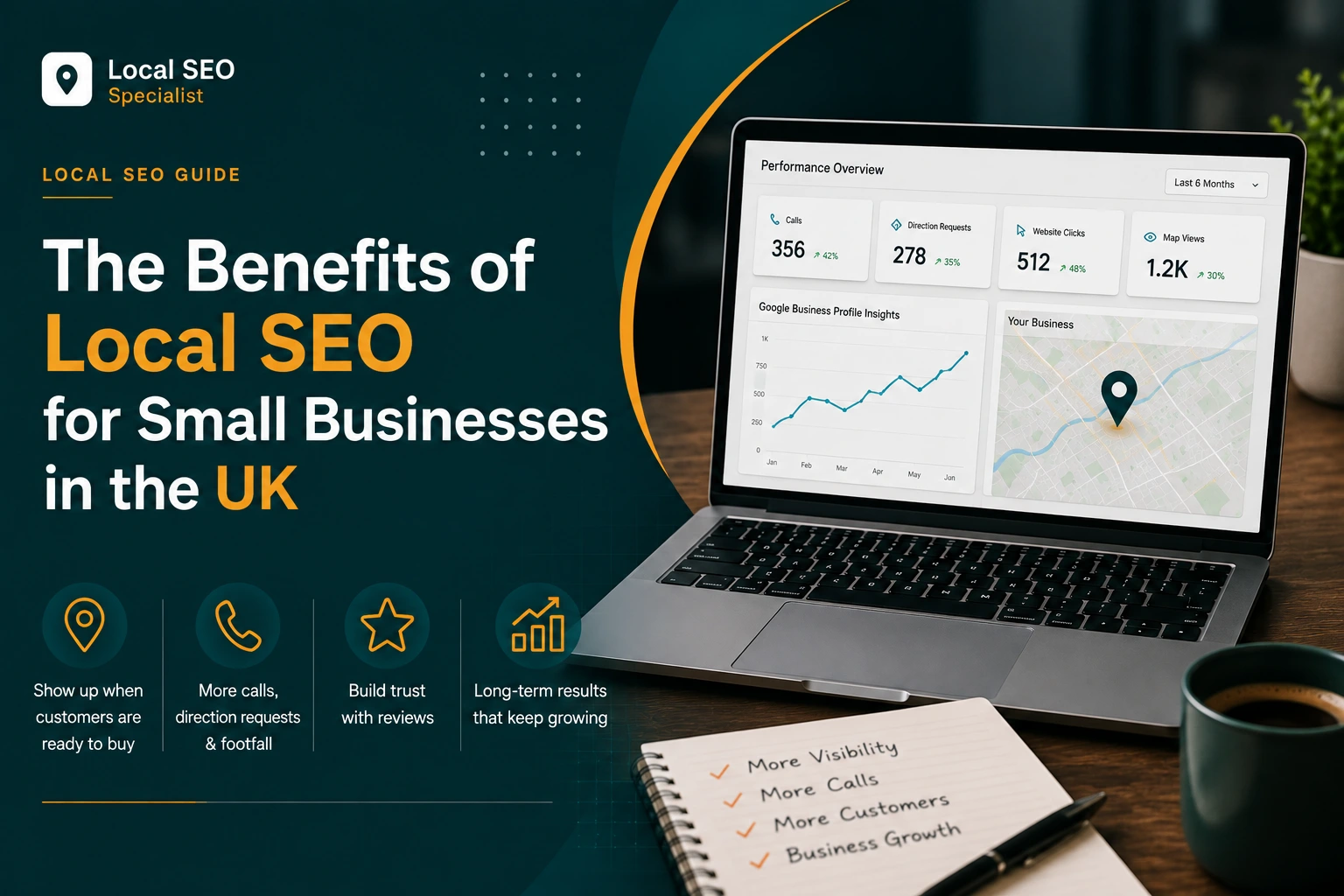
Website traffic is a vanity metric if it doesn’t turn into anything. Your Google Business Profile gives you numbers that actually mean something: how many people called you straight from the listing, how many asked for directions, how many clicked through to your site with clear buying intent.
I’ve had clients dismiss local SEO early on because their website traffic barely moved. Then we pulled the GBP insights and found forty calls a month coming directly off the profile, never touching the website at all. Those calls don’t show up in Google Analytics. They show up in your appointment book.
3. Leads Without Paying Per Click
The average Google Ads cost per click across UK industries sits around £1.95 on Search, and local service categories like trades and home services often run £2 to £5 a click before you’ve even landed a lead. Every one of those clicks costs money whether it converts or not.
Local SEO leads don’t work that way. Once you rank, a customer finding you through the map pack costs nothing beyond the time you already put into optimising your profile. That’s not a small difference over a year. It’s the entire economics of your marketing budget shifting in your favour.
4. You Compete With Big Brands on a Level Playing Field
National brands win on organic search through sheer domain authority. They’ve got the backlinks, the budget, the decade-old website. In the map pack, none of that carries the same weight. Proximity and relevance do most of the heavy lifting instead.
A one-location tradesperson with a properly filled-out profile and a steady flow of recent reviews can beat a franchise with fifty locations and a bigger name, provided that franchise hasn’t bothered optimising the one profile that actually serves your area. Most haven’t. That’s your opening.
5. Reviews Build Trust Before Customers Ever Contact You
Ninety-seven percent of consumers read reviews before choosing a local business, and most check more than one platform before deciding. By the time someone calls you, they’ve already decided you’re trustworthy. The sales conversation is half done before it starts.
We’ve seen this play out again and again with UK trades clients specifically. A business with forty reviews from the past six months, replied to consistently, will out-convert a competitor sitting on three hundred reviews that stopped in 2021. Recency reads as “still operating, still good.” A stale pile of five-star ratings doesn’t tell anyone anything about today.
6. Results Compound Over Time (Unlike Ads That Stop When You Stop Paying)
Turn off a Google Ads campaign, and your visibility disappears the same afternoon. Local SEO doesn’t work like a tap you switch on and off. It’s closer to buying a shopfront instead of renting one.
The reviews you’ve earned stay earned. The citations you’ve built stay built. The rankings you’ve climbed don’t reset to zero the month your budget gets tight. That’s the asset-versus-rent argument in one sentence, and it’s the single biggest reason local SEO outperforms paid ads on any timeframe past about six months.
7. You Get Recommended by AI Search, Not Just Google
This is the benefit almost nobody’s writing about yet, and it’s about to matter a lot more. AI Overviews and tools like ChatGPT are naming two or three local businesses directly in their answers now, pulled straight from Google Business Profile data, review content, and structured markup on your site.
A business can rank fine in a normal search and still never get named in an AI-generated answer. Being visible in that context takes the same groundwork as normal local SEO, but it rewards it differently, and it’s a channel your competitors likely haven’t touched yet. Early advantage, plain and simple.
8. Every Pound Is Measurable
No guesswork here. Calls, form fills, direction requests, and website clicks are all tracked through your Google Business Profile, Google Analytics 4, and Search Console. You can see exactly what your local SEO spend is producing, month by month, in a way plenty of “brand awareness” marketing never lets you see.
Key Takeaway: Local SEO turns your service area into a source of leads that keeps producing after the initial work is done, and every part of it can be tracked back to a real business outcome.
Local SEO vs Paid Ads: Which Is Better for a Small Business Budget?
Neither wins outright. That’s the honest answer, and it’s the one most agencies won’t give you because it doesn’t push you toward whichever service they’re selling.
| Factor | Local SEO | Paid Ads |
| Speed to first result | 4–8 weeks | Same day |
| Cost over 12 months | Lower, front-loaded effort | Ongoing, scales with clicks |
| What happens when you stop | Rankings largely hold | Visibility stops immediately |
| Trust factor with customers | High, organic result | Lower, flagged as “Ad” |
Ads win when you need customers this week. A new business with an empty diary, a seasonal push, a slow month you need to fill fast, that’s what paid search is built for. Local SEO wins on everything past that first sprint. Most businesses I’ve worked with get the best result staging both: ads to cover the gap while local SEO climbs, then easing ad spend down as organic rankings take over the load.
Is Local SEO Worth It for a Small Business? The ROI Question
Let’s put actual numbers against this instead of talking in generalities. Take a modest UK service business; a domestic cleaning company, say, with an average job value of £120. Local SEO work brings in 15 extra enquiries a month through the map pack and organic listings, converting at a fairly typical 40%. That’s 6 new customers a month, or roughly £720 in new monthly revenue, against a typical monthly local SEO spend in the £300–£600 range for a small business. Compare that to generating the same 6 customers through paid ads at even a conservative £2.50 cost per click and a modest conversion rate, and the ad spend alone can outstrip the entire local SEO budget before you’ve covered the management fee.
It’s not worth it for everyone, and I’ll say that plainly because pretending otherwise helps nobody. A purely national e-commerce business with no physical service area gets little from local SEO specifically. Neither does a business with no defined region it serves. If that’s you, this isn’t your channel. Put the budget into organic or paid search built for national reach instead.
Case Study: One of the small businesses we’ve worked with, a two-van electrical contractor covering a single UK city, went from page two of the map pack to a consistent top-three position across their core service terms within five months. Monthly GBP-driven calls rose from around 12 to 58, and they scaled back their Google Ads spend by 60% once organic leads covered most of their capacity.
What Should Small Business SEO Services Actually Deliver?
If you’re paying someone for small business SEO services, you should know exactly what that’s meant to include. A legitimate local SEO service for small businesses covers Google Business Profile management, ongoing review generation and response, NAP citation consistency across directories, location-specific keyword targeting on your website, and monthly reporting tied to calls, direction requests, and enquiries rather than vague ranking screenshots.
Ask any firm offering local SEO services for small businesses to show you a sample report before you sign anything. If they can’t show real numbers tied to real business outcomes, that’s an answer in itself.
How to Start Benefiting From Local SEO This Month
You don’t need six months of planning to get moving. Five steps, in order:
- Claim and fully complete your Google Business Profile; hours, category, service area, photos, everything
- Start asking every happy customer for a review within an hour of the job finishing
- Fix your NAP details so your name, address, and phone number match exactly across every directory
- Add location-specific keywords to your homepage and service pages, naturally, not stuffed in
- Track your GBP insights monthly so you can see what’s actually moving
Not sure where your profile stands right now, or which of these five is costing you the most leads? Our team runs a free local SEO audit that tells you exactly that, with no obligation attached.
So, Is Local SEO Worth the Investment for a UK Small Business?
Yes, provided you serve a defined area, and you’re willing to give it more than a few weeks to work. The case for it doesn’t rest on hope. It rests on 84% of UK adults searching for local businesses weekly, on 76% of those searches ending in a visit within a day, and on 58% of UK businesses still not bothering to optimise for any of it. That gap is exactly where a well-run local SEO effort earns its keep, month after month, without a bill arriving every time someone clicks.
The businesses that lose out here aren’t the small ones. They’re the ones that decided local SEO was too slow to bother with, then watched a competitor two streets over take the calls instead.
What is the biggest benefit of local SEO for a small business?
The single biggest benefit is showing up at the exact moment someone nearby is ready to buy, without paying per click for that visibility. Reviews and map pack rankings compound over time too, so the leads keep arriving well after the initial setup work is done. For most small businesses, that combination of buy-intent traffic and durable rankings beats any other single marketing channel available to them.
How long before a small business sees results from local SEO?
Early movement in Google Business Profile visibility usually shows up within 4 to 6 weeks. Meaningful map pack ranking improvements typically take 3 to 6 months of consistent work, and competitive city-centre categories can take longer than that. Rural or less contested service areas often move faster than that average.
Is local SEO better than Google Ads for small businesses?
Neither is universally better, they solve different problems. Ads deliver visibility immediately but stop the moment you stop paying, while local SEO takes longer to build but keeps producing leads well after the active work slows down. Most small businesses get the strongest result running both together, at least early on.
How much do local SEO services for small businesses cost in the UK?
Most small businesses pay somewhere between £300 and £600 a month for ongoing local SEO management, depending on competition and how many locations are involved. That’s typically lower than an equivalent monthly Google Ads budget once cost per click is factored in, especially in local service categories.
Do you offer local SEO services for small businesses?
Yes. Our local SEO services for small businesses cover Google Business Profile management, review generation, citation cleanup, and location-targeted content, all reported monthly against calls and enquiries. If you’d like a clearer picture of where your business currently stands, our free local SEO audit is the easiest place to start.
