
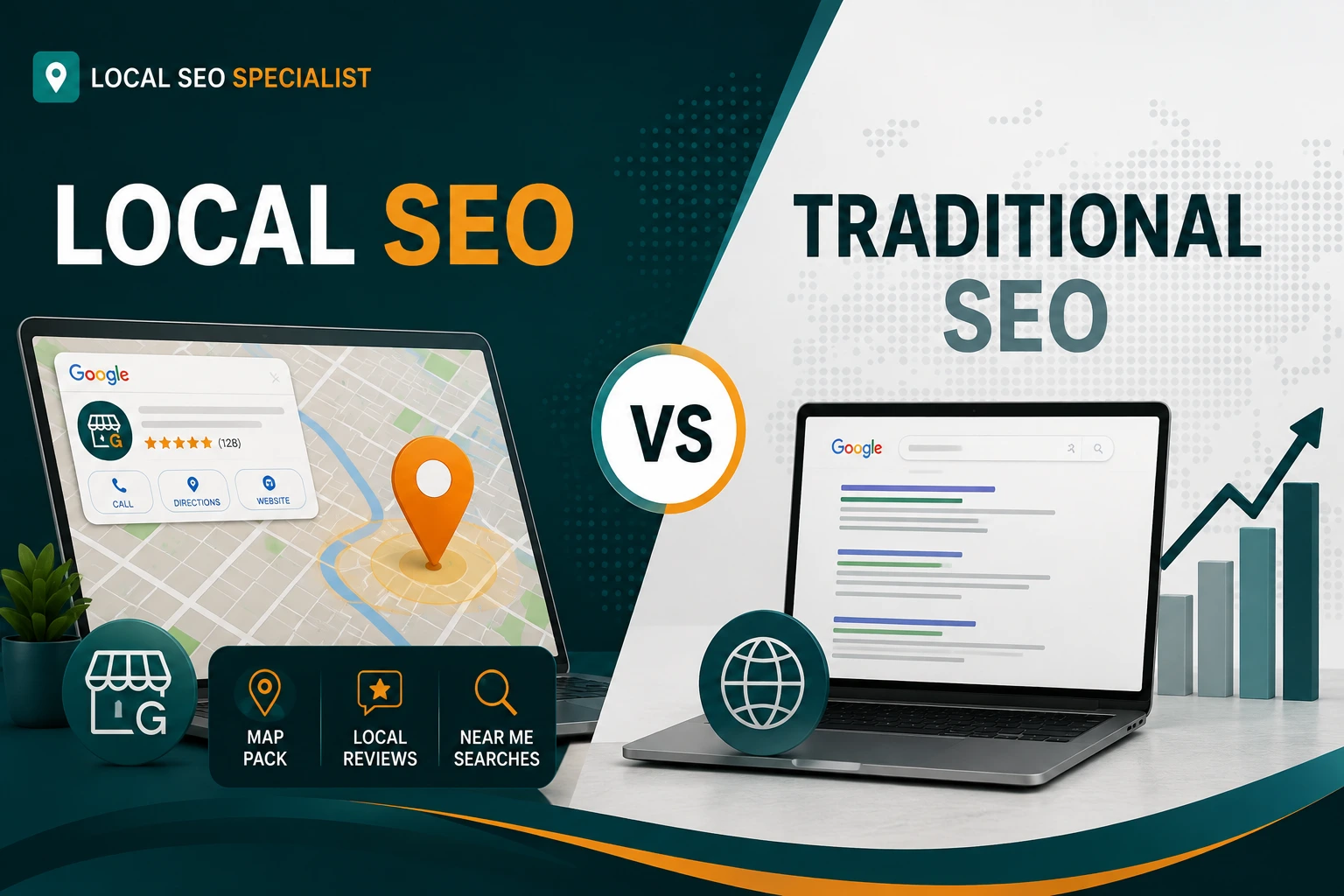
Key Takeaways (TLDR)
- The core difference is who you’re trying to reach. Traditional SEO targets searchers anywhere. Local SEO targets customers in your service area.
- Local SEO wins the map pack through your Google Business Profile and reviews. Traditional SEO wins organic rankings through content and links.
- Quick rule: serve a defined area, go local first. Sell nationally online, go traditional first. Most UK businesses need a weighted mix, not a choice.
- Both now feed AI search results. Google’s AI Overviews draw on organic content authority and local trust signals together.
The difference between local SEO and traditional SEO comes down to who you’re actually trying to reach. Traditional SEO makes your website visible to searchers anywhere in the world. Local SEO makes your business visible to the person standing three streets away, phone in hand, ready to book.
This matters because most business owners get sold “SEO” as if it’s one product. It isn’t. Nearly half of all Google searches now carry local intent, and that share has climbed steadily as mobile search took over. Pick the wrong discipline, and you’re paying to reach an audience that was never going to walk through your door.
We manage both types of campaigns for UK businesses every week, and the confusion is almost always the same. A client wants “SEO” and assumes one strategy covers both jobs. This guide breaks down what each approach actually does, the differences that change your budget, and a simple framework for deciding where your money should go first.
What Is Traditional (Organic) SEO?
Traditional SEO, also called organic SEO, is the process of improving a website’s visibility in standard search results with no location attached. It targets keywords like “best accounting software” or “how to fix a leaking tap,” and success is measured through organic rankings, traffic, and conversions rather than map pack visibility.
The work covers keyword research, content creation, on-page optimisation, technical fixes, and link building. These search engine optimisation services build sitewide authority over time, and that authority compounds. A page you publish this year keeps sending traffic next year, and the year after that, long after the invoice is paid.
Traditional SEO suits businesses whose customers could genuinely be anywhere. Think e-commerce stores, SaaS companies, national brands, and publishers. If your buyer doesn’t care what town you’re based in, this is where your budget belongs.
What Is Local SEO?
Local search engine optimisation is the process of making your business visible when people nearby search for what you offer. It targets queries like “accountant in Sheffield” or “emergency plumber near me,” and success shows up in the map pack, Google Maps, phone calls, and direction requests.
The work centres on your Google Business Profile, NAP citations, customer reviews, location pages, and local links. I’ve sat in enough client meetings to know this list sounds dull compared to a flashy content strategy. It isn’t glamorous. It’s also the part that decides whether the plumber down the road gets the call instead of you.
For the full breakdown of how each piece fits together, see our complete guide to what local SEO is and how it works. Local SEO suits any business serving a defined area: trades, clinics, salons, restaurants, solicitors, estate agents, the list goes on.
Local SEO vs Traditional SEO: 7 Key Differences
Here’s the full comparison at a glance. Three of these differences change actual buying decisions, and we’ll unpack those below the table.
| Difference | Traditional SEO | Local SEO |
| 1. Target audience | National or global searchers | Customers within your service area |
| 2. Search intent | Informational and broad commercial | High-intent, ready-to-buy local queries |
| 3. Ranking system | Organic algorithm: content, links, usability | Local algorithm: relevance, distance, prominence |
| 4. Key ranking factors | Content quality, backlinks, technical health | Google Business Profile, reviews, citations |
| 5. Where results appear | Standard organic listings (blue links) | Map pack, Google Maps, localised organic |
| 6. Keyword patterns | “best CRM software”, “how to…” | “service + town”, “near me” |
| 7. Success metrics | Rankings, organic traffic, conversions | Map pack positions, calls, direction requests |
Different Ranking Systems
Google runs two separate systems side by side, and Google evaluates local and organic results using different ranking signals. The local pack is ranked by relevance, distance, and prominence, signals tied directly to your Business Profile and reputation. Organic listings are ranked by content quality, links, and page experience.
That’s why a business can dominate one system and be completely invisible in the other. A gorgeous website with a neglected profile wins organic search and still misses the map entirely. We’ve had clients ask why their beautiful new site isn’t bringing in calls, and the honest answer is usually sitting in an abandoned Google Business Profile. For the full signal breakdown, read our guide to local SEO ranking factors.
Different Keyword Intent
The same customer need produces two completely different searches. One is a research query. The other is a purchase query with a location bolted on.
| Traditional SEO query | Local SEO query |
| “how to fix a leaking tap” | “emergency plumber Cardiff” |
| “best wedding photography styles” | “wedding photographer in Leeds” |
| “do I need a will solicitor” | “will writing solicitor near me” |
Local queries often convert faster because they usually show stronger buying intent. Google’s own research shows that 76% of people who search for something nearby on their phone visit a business within 24 hours. Traditional queries build an audience over months. Local queries book jobs by tomorrow afternoon.
Different Success Metrics
Traditional SEO reports rankings, impressions, and sessions. Local SEO reports what a business owner actually feels: phone calls, direction requests, form fills, footfall through the door. If your agency only ever shows you traffic graphs for a local business, they’re measuring the wrong thing entirely.
That’s the part most business owners miss when they’re comparing agencies. Ask what a report will actually track before you sign anything.
What This Means: Judge each discipline by its own scoreboard. Traffic for traditional SEO, calls and map pack visibility for local. Mixing the two up is how businesses end up disappointed with strategies that were actually working fine.
Can Local SEO and Traditional SEO Work Together?
Yes, and for most local businesses, they reinforce each other directly. Website authority built through traditional SEO feeds the prominence signal in local rankings, while an active Business Profile drives branded searches that strengthen organic performance in return.
Here’s a practical example. A Bristol roofing firm publishes a genuinely useful guide to flat roof costs. The guide earns links and organic traffic over the following months. That authority lifts the firm’s map pack position for “roofers Bristol,” and the calls start coming in. One piece of content, two ranking systems fed at once. We’ve seen this exact pattern play out often enough that we now build it into every content plan we write for trades clients.
How Does AI Search Change This Comparison?
AI results now blend both signal sets rather than favouring one. Google’s AI Overviews cite pages with genuine content authority, which is a traditional SEO strength. AI-generated local recommendations lean on Business Profile data, reviews, and structured data, which is squarely local SEO territory.
Honestly, this is where a lot of local SEO advice falls apart, because it still treats these as two unrelated worlds. They aren’t anymore. Search engines and AI assistants are starting to shortlist a handful of businesses by name rather than handing over a full page of results, and the businesses that only invested in one discipline are the ones left out of that shortlist. Doing the fundamentals well is worth more now, not less.
Which Type of SEO Does Your Business Need? A Decision Framework
Very few businesses need a pure strategy in either direction. The real question isn’t which one to choose; it’s how to weight your budget between the two. Use the three steps below.
1. Choose by Business Type
| Business type | Recommended split (Local / Traditional) | Why |
| Trades & service-area businesses (plumbers, electricians, roofers) | 80 / 20 | Buyers search “service + town” with urgent intent; the map pack wins the job |
| Clinics, dentists, salons, restaurants | 80 / 20 | Customers choose from nearby options; reviews and Maps visibility decide |
| Solicitors, accountants serving a region | 60 / 40 | Local trust wins clients, but advice content builds authority and referrals |
| Retailer with a shop and online store | 50 / 50 | Footfall needs local; e-commerce revenue needs organic rankings |
| National e-commerce or B2B SaaS | 20 / 80 | Customers are everywhere; content and links drive growth |
2. The 30-Second Self-Diagnosis
Answer these four questions honestly. If your answers point to a defined area, local SEO should lead your strategy.
- Do customers visit your premises, or do you visit them?
- Does “near me” or a town name describe how your buyers search?
- Do you sell products or services outside your area online?
- Is your main competition local businesses or national brands?
3. How Should You Split a Limited Budget?
Say you’re working with roughly £500 a month to spend. We’d recommend starting local-first. Months one to three go on a Business Profile overhaul, citations, review generation, and location pages. From month four, reinvest the early wins into content that serves both systems at once.
Starting local-first produces measurable calls sooner, and that early return on investment is what funds the longer, slower traditional SEO build. Doing it the other way round tends to leave owners nervous before the organic results ever show up.
What This Means: Match the split to your actual business model. Area-serving businesses should weight local first, and the self-diagnosis above settles it in under a minute.
What Does Each Cost in the UK?
Costs vary by market and competition, but here’s what we typically see across UK campaigns.
| Strategy | Typical UK monthly cost | Time to first results |
| Local SEO (single location) | £300-£800 | 3-6 months; GBP wins often sooner |
| Traditional SEO (SME site) | £600-£1,500+ | 6-12 months |
| Combined programme | £750-£2,000 | Local wins first, organic compounds behind |
Local SEO usually delivers a return faster for area-serving businesses. The audience is smaller, the intent is higher, and the map pack simply refreshes quicker than organic rankings ever do.
We ran this exact playbook for a client in the trades sector last year. Their profile was three years out of date and sitting outside the map pack entirely for their core service term. Within two months of a profile overhaul, fresh reviews, and consistent citations, they moved into the top three results and started fielding calls they’d never seen before. Not a miracle. Just the basics done properly, finally.
Not Sure Which You Need? Start With an Audit
Most businesses need a blend of both, weighted toward whichever side matches how their customers actually search. If you serve a defined area and your buyers type “near me” or a town name, local SEO should lead your budget. If your customers could be anywhere and buy online, traditional SEO earns the bigger share.
You don’t have to guess at this. Our team runs a free visibility audit that shows exactly where your gaps sit, whether that’s the map pack, organic results, or both, along with a sensible budget split for your market. Explore our local SEO services or request the audit to request the audit to receive a practical recommendation based on your current visibility.
What is the main difference between local SEO and traditional SEO?
The main difference is the audience each one targets. Traditional SEO improves a website’s visibility for searchers anywhere using content, links, and technical optimisation. Local SEO improves a business’s visibility for nearby searchers using the Google Business Profile, reviews, and citations to rank in the map pack and Google Maps.
Do I need both local SEO and traditional SEO?
Most businesses serving a physical area benefit from both, weighted by business model. A trades business might weight 80% local, while a retailer with an online store splits evenly at 50/50. A purely online business with no service area gains little from local SEO and should focus on traditional SEO instead.
Which is cheaper, local SEO or traditional SEO?
Local SEO is generally cheaper for a single-location business, with UK campaigns typically running £300 to £800 a month. Traditional SEO usually costs more, closer to £600 to £1,500 or beyond monthly, because it demands ongoing content production and link building at scale. Local SEO also tends to show results sooner, since the competition is limited to one area.
Can I rank organically without doing local SEO, and vice versa?
Yes, in both directions, because Google runs two separate ranking systems. A website can rank organically through content, links, and technical quality with zero local optimisation. A business can also appear in the map pack through a well-optimised profile and strong reviews even with a weak website, though the two feed each other over time.
How do you decide which SEO strategy a business needs?
The decision rests on where a business’s customers are and how they search. Area-serving businesses whose buyers search “service + town” need a local-first strategy, while national sellers need a traditional-first one. A visibility audit settles it with real data rather than guesswork, benchmarking map pack presence, organic rankings, and competitor gaps before recommending a split.
