
Key Takeaways
- Local rankings come down to three pillars: relevance, distance, and prominence. Everything else is a symptom of one of those three.
- The map pack and local organic results don’t weigh factors the same way. You can dominate one and barely register in the other.
- The factors you actually control: your Google Business Profile, your reviews, your on-page setup, your links, and your citations.
- Negative factors can wipe out months of good work in a single afternoon. We’ll show you exactly what to avoid.
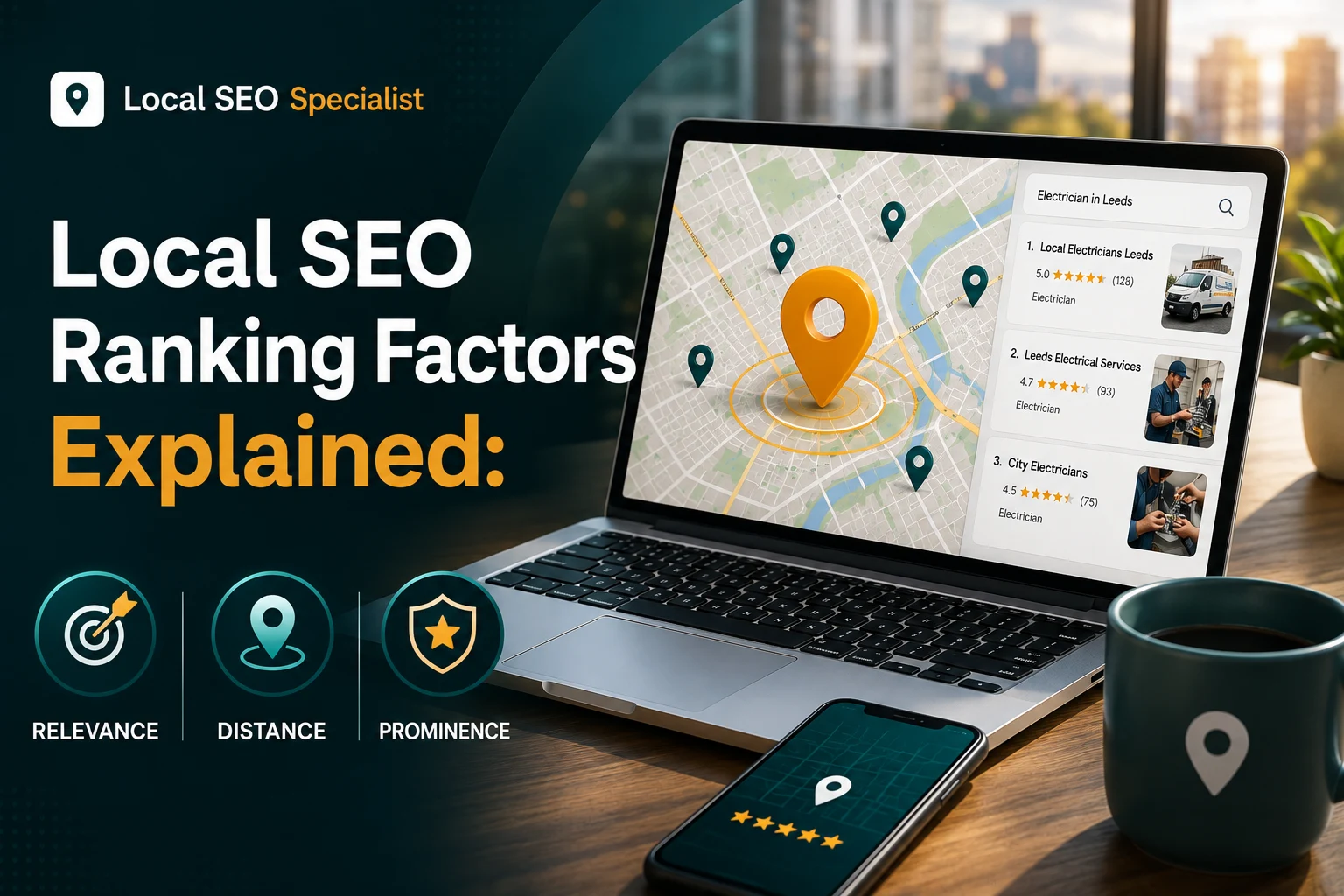
Type “emergency electrician Leeds” into Google and three businesses show up before you’ve even scrolled. Local rankings are decided by three things: relevance, distance, and prominence. Understanding these signals is the foundation of effective local search engine optimisation, and it’s where most business owners get the order of operations wrong. Everything Google measures about your business gets sorted into one of those buckets.
That sounds simple. It isn’t, and here’s why: most business owners fix the wrong bucket first. They chase backlinks when their Google Business Profile is half-empty, or they obsess over reviews when their listing isn’t even verified in the right category. Google’s own guidance confirms the three-pillar model, and the yearly Whitespark Local Search Ranking Factors survey, which pulls in dozens of working local SEO experts every cycle, backs it up with real weighting data, not guesswork.
If you’re a business owner staring at a competitor who somehow outranks you despite having a worse website, fewer reviews, or a less convenient location, this guide is for you. We’ll walk through what actually moves the needle, in the order it moves it.
What Are Local SEO Ranking Factors?
Local SEO ranking factors are the signals Google checks before deciding which businesses to show for a nearby search. You’ll sometimes see these called Google local ranking factors, but the underlying signals are the same. Not a handful of signals, either. The current Whitespark survey tracks 187 of them, grouped into relevance, distance, and prominence.
Some of these you control directly, like your business category or your review count. Others you barely influence at all, like how far a searcher happens to be standing from your door. Understanding the difference is the whole game. Chase the controllable ones first, and stop losing sleep over the ones you can’t touch. For a fuller walkthrough of how local SEO fits together as a discipline, our pillar guide on what local SEO actually is is a good next stop.
The Three Pillars: How Does Google’s Local Algorithm Work?
Google’s local algorithm runs every search through three filters at once: does this business match what was typed, how close is it, and how trustworthy does it look? Nail all three, and you’re in the map pack. Miss one badly and nothing else matters.
- Relevance matching the query
Relevance is Google checking whether your business actually offers what someone searched for. Your primary category, the services listed on your profile, and the content on your website all feed this. List yourself as “Electrician” when you only do commercial rewiring, and you’ll show up for searches you can’t actually serve, which hurts you more than it helps, because Google notices the mismatch in clicks and complaints.
- Distance (Proximity) and the honest bit
Distance is exactly what it says. Google estimates how far your business is from the searcher, or from the location typed into the search box. Here’s the part most guides won’t tell you straight: you cannot out-optimise geography. A locksmith in Headingley is never going to consistently beat a locksmith two streets from a searcher in Chapel Allerton, no matter how good the website is. This is especially true for ‘near me’ searches, where Google weights proximity far more heavily than it does for broader city-wide queries.
What that means practically is worth sitting with. If you’re losing to a closer competitor for hyper-local searches, more content isn’t the fix. A second, genuinely staffed location closer to that demand pocket might be. Otherwise, put your energy into searches where distance isn’t the deciding factor, broader city-wide terms, service-area categories, and queries where prominence can outweigh a few miles.
- Prominence reviews, links, citations, brand mentions
Prominence is Google’s read on how well-known and well-regarded your business is, based on reviews, citations, backlinks, and how often you’re mentioned online. This is the pillar with the most room to move, and it’s the one we spend most of this article on.
Compare “emergency electrician Leeds” with “electrician near me” typed by someone standing in Roundhay. Same trade, same city, wildly different results, because the balance between distance and prominence shifts depending on how specific the search is.
Key Takeaway: Relevance and distance set the ceiling on where you can rank. Prominence decides who wins within that ceiling, and it’s the one you can build.
Map Pack vs Local Organic Results: Two Different Ranking Systems
Google actually runs two separate races that determine your Google Maps ranking and your visibility in local search. One decides your spot in the three-listing map pack. The other decides where you land in the regular blue-link results underneath it. They don’t use the same scoring.
| Factor Group | Local Pack Weight | Localised Organic Weight |
| Google Business Profile signals | ~32% | ~10% |
| Review signals | ~16% | ~7% |
| On-page website signals | ~14% | ~32% |
| Link signals | ~13% | ~22% |
| Behavioural signals | ~8% | ~9% |
| Citation signals | ~11% | ~7% |
| Personalisation | ~6% | ~5% |
(Weightings adapted from Whitespark’s Local Search Ranking Factors survey data, treat as directional, not exact percentages, since Google never publishes its actual formula.)
This table explains a confusion we hear constantly from clients: “why do I rank in the map pack but I’m nowhere in the regular results, or the other way round?” It’s because you’re strong in one system’s priorities and weak in the other’s. A business with an immaculate Google Business Profile and thin, dated website content will often win the map pack and lose the organic listings sitting right below it.
Key Takeaway: If your map pack spot is solid but your organic ranking is nowhere, stop tinkering with your Business Profile and go fix your website content instead. Different problem, different fix.
The 8 Local Ranking Factors That Matter Most (In Order)
| Factor | Importance | Effort to Influence | Realistic Timeframe |
| 1. Google Business Profile signals | Highest | Low | 2–4 weeks |
| 2. Review signals | Very high | Medium | 4–8 weeks |
| 3. On-page signals | High | Medium | 4–12 weeks |
| 4. Link signals | High | High | 3–6 months |
| 5. Behavioural signals | Medium | Medium | Ongoing |
| 6. Citation signals | Medium | Low | 2–6 weeks |
| 7. Proximity | Low (limited control) | Low | N/A |
| 8. Personalisation | Very low | None | N/A |
1. Google Business Profile Signals
Your Business Profile is the single biggest lever you have, and it’s also the one businesses half-finish the most. Primary category, secondary categories, a full services list, business description, opening hours, and how recently you’ve posted or added photos all get weighed here.
We’ve audited profiles missing a primary category entirely. Not a rare mistake, either. It happens more than you’d think, and it’s a five-minute fix that can shift a listing from invisible to competitive within a couple of weeks.
2. Review Signals
Volume matters less than it used to. Velocity and recency now carry serious weight, alongside your average rating, whether reviewers mention your service or keywords naturally, and whether you actually reply. A business with 40 reviews from the last two months will often out-rank one sitting on 300 reviews that stopped coming in back in 2022.
One UK-specific note worth knowing: since April 2025, fake and concealed incentivised reviews are banned outright under the Digital Markets, Competition and Consumers Act, and the CMA has been actively sweeping business websites to check compliance. Buying reviews or offering discounts for five-star ratings isn’t just risky for your rankings anymore. It’s a legal problem too.
3. On-Page Signals
This is your website doing its share of the work: dedicated location pages if you serve multiple areas, title tags that include your service and city, NAP details matching your listings exactly, and LocalBusiness schema markup sitting in the code where Google can read it. Skip this, and you’re leaning on your Business Profile alone to do a job it was never built to do by itself.
4. Link Signals
Backlinks still count, but not generic ones. Local relevance beats raw authority here. A mention from your regional press, a listing on a chamber of commerce site, or a sponsorship page for a local sports club will often outperform a random national directory link that has nothing to do with your area.
5. Behavioural Signals
Clicks, calls, direction requests, and how long people engage with your listing all feed back into the algorithm. This is the factor most competitors ignore completely, which makes it one of the easier ways to pull ahead. If your profile gets engagement, Google reads that as a business worth showing more often.
6. Citation Signals
NAP citations are just your business name, address, and phone number listed consistently across directories. They matter less than they did five years ago, but inconsistency still causes real damage. In the UK, that means checking your listing matches across Yell, Thomson Local, and Checkatrade, not just Google itself. One directory spelling “Street” and another abbreviating it to “St.” sounds trivial. It quietly erodes trust signals you didn’t know you had.
7. Proximity
We covered the honest version of this earlier. What you can actually influence here is limited to setting an accurate service area, or opening an additional location if the economics genuinely support it. Beyond that, proximity is Google’s job, not yours.
8. Personalisation
Search history, device type, and time of day all shape individual results slightly. There’s nothing to optimise here. It’s worth knowing it exists so you don’t panic when two people search the same term and see different results.
Key Takeaway: Fix your Google Business Profile first, reviews second, and your website third. That order isn’t arbitrary; it matches both the effort required and the speed of the payoff.
Negative Ranking Factors: What Gets You Filtered or Suspended
Positive optimisation only gets you so far if you’re also tripping filters Google uses to catch manipulation. These are the ones we see wreck otherwise solid profiles.
Keyword-stuffed business names, like adding “Best Plumber London Emergency 24/7” into your actual listed name, are an easy flag. Fake or incentivised reviews are now both a ranking risk and, in the UK, a legal one. Using a virtual office or PO box as your listed address when you don’t operate from there breaches Google’s guidelines outright. Inconsistent NAP details across the web weaken the trust signals your prominence depends on. Review gating, filtering unhappy customers away from leaving public reviews while funnelling happy ones straight to Google, also breaches guidelines and can trigger a suspension. Duplicate listings for the same business, often created by accident during a rebrand or a move, split your signals across two profiles instead of strengthening one.
A suspension isn’t subtle. Your listing disappears from Maps and search entirely, sometimes with no warning beyond a brief notification buried in your dashboard. Recovery is possible through Google’s reinstatement process, but it isn’t fast. We’ve seen it take anywhere from a few days to several weeks, and appeals get rejected more often than business owners expect on the first attempt.
How Do Ranking Factors Feed AI Search Results?
So does any of this still matter now that AI Overviews and AI-generated local results are everywhere? Yes. The same factors feed them, just with higher stakes attached. Google’s AI Overviews and the local results surfaced inside them draw directly from your Business Profile data, your review content, and the same structured signals covered above.
That’s an important update on where a lot of older SEO advice has stalled. Guidance written before AI Overviews rolled out at scale treats this as a future consideration. It isn’t anymore. A thin, inconsistent profile now costs you visibility in two places instead of one the traditional map pack and the AI-generated answer sitting above it.
Which Ranking Factor Is Holding Your Business Back? A Quick Diagnosis
Different symptoms point to different broken factors. Here’s how to read yours.
| Symptom | Likely Factor |
| Not showing in the map pack at all | Google Business Profile setup or verification issue |
| Ranking well near your address, invisible two miles away | Proximity combined with weak prominence |
| Showing up but the phone doesn’t ring | Reviews, photos, or an incomplete services list |
| A competitor with fewer reviews still outranks you | Relevance, check your category and service listings |
We worked with a mid-sized dental practice that ranked on page one for their core term but barely got calls from it. The diagnosis wasn’t reviews, which were already strong. It was photos. The profile had four images, all over three years old, and no interior shots at all. Adding twelve current photos and filling in the services menu properly moved their call volume noticeably within about six weeks, without touching a single backlink.
If you want a straight answer on which of these is costing you rankings specifically, hat’s exactly what we dig into with a free local SEO audit, one of the local SEO optimisation services we offer, and it’s usually a fifteen-minute conversation to find out.
What Should You Work on First?
So what’s the actual priority order? Fix your Google Business Profile first, then your reviews, then your website’s on-page signals, and treat link building as the long-term project it is.
For a typical small UK business, that looks like: claim and fully complete your profile in week one, request reviews consistently from week two onward, tidy up on-page content and schema over the following month, and only then start chasing local links and press mentions as an ongoing effort. Skipping straight to link building while your profile sits half-finished is one of the most common mistakes we see, and it’s also one of the most expensive to fix later.
Not sure where your business actually stands against that order? Our team runs a free local SEO audit that tells you which factor is genuinely costing you rankings, rather than guessing.
What are the three main local SEO ranking factors?
Relevance, distance, and prominence. Relevance is whether your business matches the search, distance is how close you are to the searcher, and prominence is built from reviews, links, and citations. Google’s own local search documentation confirms these three as the foundation everything else sits on.
What is the most important local SEO ranking factor?
Your Google Business Profile carries the heaviest weight for map pack visibility, accounting for roughly a third of local pack ranking factors according to Whitespark’s survey data. Reviews come in close behind, especially recent ones.
Why does my competitor rank higher than me on Google Maps?
Usually it comes down to one of four things: a stronger Business Profile, more recent reviews, being physically closer to the searcher, or better category and service matching. Run through the diagnosis table above, and you’ll usually spot which one applies.
Can I rank in the map pack without a physical address?
Yes, if you’re a service-area business and you set that up correctly in your Business Profile settings. You’ll still need a real, verifiable location on file with Google, even though it stays hidden from public view.
Can your team identify which ranking factors my business is missing?
Yes. Our free local SEO audit checks all eight ranking factor categories against your current profile and website, then hands you a prioritised list of what to fix first, not a generic checklist.
